Kids' Cycle Helmet: Sizes, Fitting and Safety Standards
Choose a kids' cycle helmet by head circumference, not age: measure around the widest part of the head, about 2 cm above the eyebrows. Toddlers are often 46–52 cm, young children 50–56 cm and older children 54–58 cm. Look for a recognised safety mark such as EN 1078, CPSC or AS/NZS 2063, and fit it level, two fingers above the eyebrows, with the straps snug.
- Size by head circumference
- Toddler ~46–52 cm
- Child ~50–56 cm
- Look for EN 1078 / CPSC
A good helmet is the most important accessory for any child who rides — on a tricycle, a balance bike or a 24-inch cycle. The best helmet is one that fits properly and that your child is happy to wear every time.
Kids' cycle helmet size chart
| Typical age | Head circumference | Usual helmet size |
|---|---|---|
| 1–3 years | 44–50 cm | Toddler / XS |
| 3–6 years | 48–54 cm | Kids S |
| 6–10 years | 50–56 cm | Kids M / Youth |
| 10–14 years | 54–58 cm | Youth / Adult S |
Ages are only a guide. Head sizes vary widely, so always measure.
How to measure for a cycle helmet
- Use a soft tape measure (or a piece of string and a ruler).
- Wrap it around the widest part of the head: about 2 cm above the eyebrows, above the ears and over the bump at the back.
- Read the measurement in centimetres. If it's between two sizes, choose the one where the measurement sits in the middle of the range, then fine-tune with the adjuster dial.
How to fit a kids' helmet
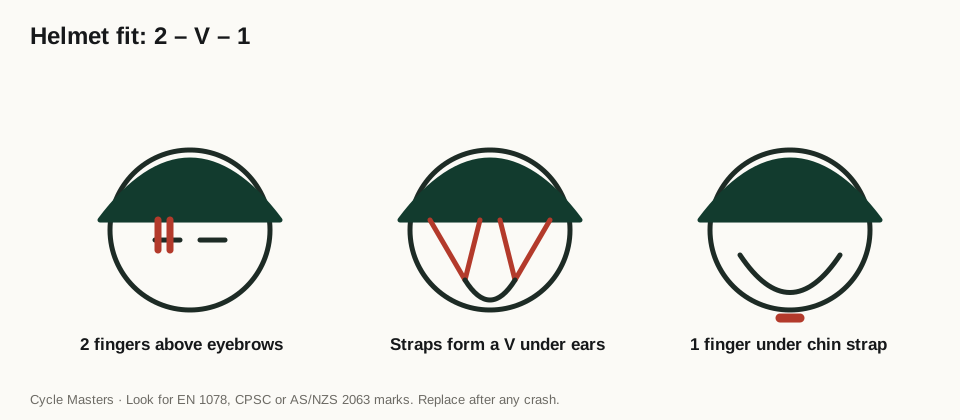
- Level: the front edge sits about two fingers' width above the eyebrows — not tipped back on the forehead.
- Snug: tighten the rear dial until the helmet doesn't rock when your child shakes their head.
- Side straps: form a V just below each ear lobe.
- Chin strap: fastened, with room for about one finger between strap and chin.
- Check: ask your child to open their mouth wide — the helmet should press down slightly on the head.
Safety marks to look for
Look for a label or sticker inside the helmet showing a recognised bicycle helmet standard:
- EN 1078 (Europe)
- CPSC 1203 (USA)
- AS/NZS 2063 (Australia/New Zealand)
Many cheap helmets sold online in Pakistan have no standard listed. If a listing doesn't mention one, ask the seller for a photo of the label. Our cycle helmet guide explains the standards in more detail.
Types of kids' helmets
- Toddler helmets: small sizes, extra coverage at the back, often a flatter back for child seats.
- Standard kids' helmets: vents for heat, adjustable dial — the right choice for most children.
- BMX/skate-style helmets: rounder, cover more of the back of the head, fewer vents. Good for scooters and skating too, but hotter in summer.
- Full face helmets: for BMX racing and downhill mountain biking only.
Pakistani heat: comfort tips
- Choose a helmet with plenty of vents and a removable, washable pad.
- Ride in the morning or evening in summer.
- Never leave a helmet in a hot car — high heat can damage the foam.
When to replace a helmet
- After any crash where the helmet hit the ground, even if no damage is visible — the foam is designed to crush once.
- When your child outgrows the size range.
- If straps, buckle or foam are damaged.
Common mistakes
- Helmet tipped back, exposing the forehead.
- Chin strap left loose or unclipped.
- Buying a size up "to grow into".
- Wearing a cap or thick hood under the helmet.
Frequently asked questions
How do I measure my child's head for a cycle helmet?
Wrap a soft tape measure around the widest part of the head, about 2 cm (one finger width) above the eyebrows and over the bump at the back. Use the measurement in centimetres to choose from the helmet's size range.
What size cycle helmet does a 5 year old need?
Many 5-year-olds measure about 50–54 cm, which is usually a kids' size S or an adjustable 'one size' kids' helmet. Measure, because head sizes vary a lot at this age.
Does a baby or toddler need a cycle helmet?
Yes, whenever they ride a balance bike, tricycle or sit in a child seat on an adult's cycle. Toddler helmets start at about 44–46 cm and should have a flat back so they don't push the head forward in a child seat.
Are full face helmets good for kids?
Full face helmets are made for BMX and downhill mountain biking, where face injuries are more likely. For everyday cycling, a standard open helmet is lighter, cooler and more comfortable.
When should a kids' helmet be replaced?
After any crash or hard knock, even if it looks fine, and when your child outgrows the size range. Many makers also recommend replacing helmets after several years because the foam and straps age, especially in heat and sun.
Do helmet safety standards matter?
Yes. A helmet tested to a standard like EN 1078, CPSC or AS/NZS 2063 has passed impact tests. Unmarked 'toy' helmets may look similar but are not tested to protect a head in a fall.
Sources & how we checked
- U.S. Consumer Product Safety Commission — Which helmet for which activity — Helmet types and standards
- NHTSA — Fitting a bike helmet — Helmet fitting steps
Prices and availability in Pakistan change often. Spotted something out of date? Tell us and we'll check and correct it.
Tell us the rider's height, age and budget — we'll recommend a bike, whether or not we stock it.
Related guides
Parts & accessoriesCycle Helmet Guide: Choosing, Fitting and Replacing a Bicycle HelmetHow to choose a cycle helmet in Pakistan for adults and kids: safety standards to look for, the 2-finger fit test, ventilation for heat, and when to replace.Read guide → Kids' & baby cyclesCycle for Kids: How to Choose the Right Children's CycleHow to choose a cycle for kids in Pakistan: the right size for each age, tricycle vs balance bike, training wheels, brakes, weight and safety tips.Read guide →Kids' & baby cyclesHow to Teach a Child to Cycle (Without Training Wheels)A calm, step-by-step way to teach a child to cycle without stabilisers: set-up, gliding, first pedal strokes, steering and braking, plus common problems.Read guide →Kids' & baby cyclesBaby Cycle and Tricycle Guide: Choosing a First Ride for Ages 1–4Baby cycles explained: tricycles, push-handle trikes, balance bikes and 12-inch cycles for ages one to four, with safety checks and prices in Pakistan.Read guide →