Fixie and Single-Speed Cycles: What They Are and Who Should Ride One
A fixie (fixed-gear cycle) has one gear and no freewheel — when the wheel turns, the pedals turn, so you can't coast. A single-speed cycle also has one gear but does have a freewheel, so you can stop pedalling. Fixies are light, simple and stylish, but for most riders in Pakistan a single-speed with two hand brakes is safer and easier.

- Fixie: can't stop pedalling
- Single speed: can coast
- Light and simple
- Always fit hand brakes
Fixies became popular worldwide for their clean look and simplicity. They're fun — but they ride very differently from a normal cycle.
Fixie vs single speed vs gears
| Fixie | Single speed | Geared | |
|---|---|---|---|
| Gears | One | One | 7–30 |
| Can you coast? | No | Yes | Yes |
| Weight | Lightest | Very light | Heavier |
| Maintenance | Minimal | Minimal | More |
| Hills | Hard | Hard | Easy |
How riding a fixie feels
Because the pedals always turn, you control speed with your legs as well as the brakes. Riders say it feels very connected to the road. But you can't stop pedalling on descents, and cornering with a pedal down can scrape.
Pros
- Very light and simple; few parts to break.
- Cheap to maintain.
- Stylish, minimal look.
Cons
- Hard on hills and in headwinds.
- Takes practice; not ideal for beginners or children.
- Risky without hand brakes.
Who should ride one
Experienced riders on flat cities who enjoy simplicity. For most people, a single-speed with a freewheel and two brakes gives the same simplicity with less risk. If you face hills, choose gears — see the gear cycle guide.
Flip-flop hubs
Many fixies have a rear hub with a fixed cog on one side and a freewheel on the other. Remove the wheel, flip it and re-tension the chain to switch between fixie and single-speed.
For fast riding generally, see speed cycles and sports cycles.
Gear ratio for a single-speed or fixie
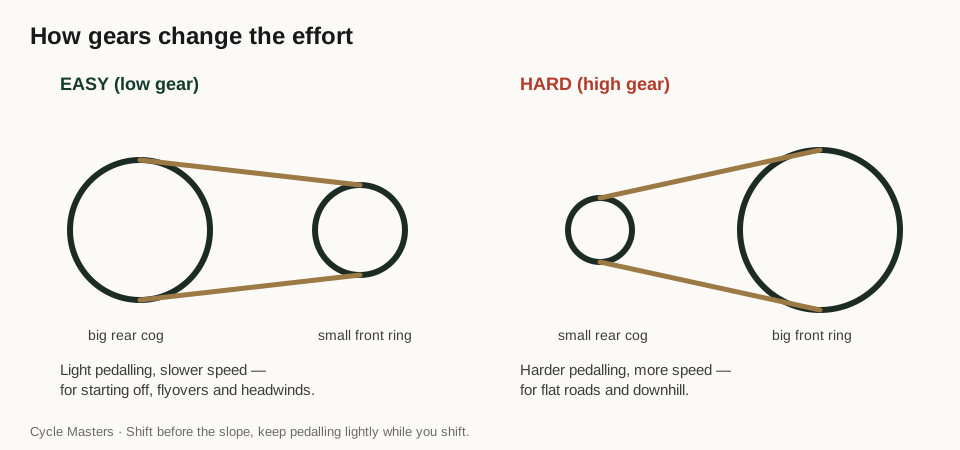
Because there is only one gear, choosing the ratio matters. A lower ratio (smaller front chainring or larger rear cog) is easier on hills and starts but limits top speed; a higher ratio is faster on flat roads but harder to start. Most city riders are comfortable with a moderate ratio, and many shops can swap the rear cog to fine-tune it.
Maintaining a single-speed
The main job is keeping the chain at the right tension: about 1–1.5 cm of up-and-down movement midway between the chainring and cog. Too loose and it can fall off; too tight and it wears quickly. Oil the chain regularly and check the rear wheel nuts are tight.
Frequently asked questions
What is a fixie cycle?
A fixed-gear bicycle where the rear cog is fixed to the hub, so the pedals always turn with the wheel. Riders can slow down by resisting the pedals.
Is a fixie good for beginners?
Usually not. Not being able to coast takes practice. A single-speed or geared cycle with two hand brakes is easier and safer.
Can a fixie have brakes?
Yes — and it should for road riding. Fit at least a front brake, ideally front and rear.
Can I convert a fixie to single speed?
Many fixies have a 'flip-flop' rear hub with a fixed cog on one side and a freewheel on the other — just flip the wheel.
Tell us the rider's height, age and budget — we'll recommend a bike, whether or not we stock it.
Related guides
 Types of cyclesGear Cycle vs Non-Gear Cycle: Which Should You Buy?Gear cycle or non-gear cycle? How bicycle gears work, how many you need, how to shift properly, and which type suits Pakistani roads and riders.Read guide →
 Types of cyclesSports Cycle and Racing Cycle Guide: What They Are and Who They SuitWhat 'sports cycle' and 'racing cycle' mean in Pakistan, the difference between road, hybrid and mountain-style sports cycles, and how to choose one.Read guide →Types of cyclesSpeed Cycles: What Makes a Cycle Fast, Top Speeds and SpeedometersWhat makes a cycle fast, typical speeds for different riders and cycles, the fastest cycle types, how gears affect speed, and cycle speedometers.Read guide →
 Parts & accessoriesDisc Brake Cycle Guide: Mechanical vs Hydraulic, Repair and MaintenanceWhat a disc brake on a cycle is, mechanical vs hydraulic disc brakes, disc vs V-brakes, fixing rubbing and squealing discs, and replacing pads.Read guide →