Mini Cycle Pedal Exerciser (Mini Exercise Cycle): Uses and Buying Tips
A mini pedal exerciser is a small, portable frame with two pedals and a resistance knob that you use sitting on a chair (for legs) or at a table (for arms). It's good for gentle movement — older adults, desk workers and people recovering from injury (with medical advice) — but it doesn't replace a full exercise bike for fitness. Look for a stable, non-slip base, smooth adjustable resistance and a counter.
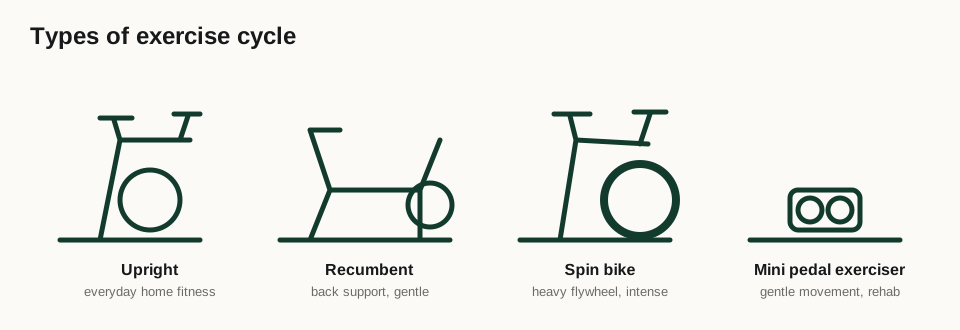
- Use seated, legs or arms
- Gentle, low-impact movement
- Not a full workout bike
- Stable base + smooth resistance
Mini pedal exercisers are small, cheap and easy to store — which is why they're popular gifts for parents and grandparents. Here's what they're good for and what they're not.
What it is
A mini pedal exerciser (also sold as a "mini exercise cycle" or "pedal cycle for exercise") is just the pedal part of an exercise bike: two pedals on a small frame, with a knob to adjust resistance and often a small counter showing time, count and estimated calories.
How to use it
For legs: place it on the floor in front of a sturdy chair without wheels. Sit upright, feet on the pedals, and pedal smoothly for 5–15 minutes.
For arms: place it on a table and turn the pedals with your hands.
Start with low resistance and short sessions; increase slowly.
Who it suits
- Older adults who want gentle daily movement.
- Desk workers who sit for long periods.
- People recovering from injury or surgery — only as advised by a doctor or physiotherapist.
- Anyone short on space who wants light activity while watching TV.
Benefits and limits
| Good for | Not ideal for |
|---|---|
| Gentle movement and circulation | Weight loss and fitness on its own |
| Joint mobility | High-intensity training |
| Using while seated | Standing or vigorous use |
For a real workout, see the exercise cycle guide and cycling for weight loss.
What to check before buying
- Stable, non-slip base — cheap models slide on tiles; a mat helps.
- Smooth resistance — magnetic is quieter than friction-strap types.
- Pedal straps to keep feet in place.
- Display that's easy to read.
- Folding frame for storage.
Pedal exerciser vs exercise bike
An exercise bike supports your whole body weight and allows much more effort and longer sessions. A mini exerciser is a gentle tool for movement. For more on pedals and pedal-free cycles, see the pedal cycle guide.
A simple daily routine
- Two minutes easy pedalling to warm up.
- Five to eight minutes at a comfortable resistance.
- Two minutes easy to finish.
Repeat once or twice a day. For arms, do shorter sets of two to three minutes. The goal is regular movement, not exhaustion.
Choosing between friction and magnetic models
Friction models use a strap or pad against a flywheel; they are cheaper but can be noisier and less smooth. Magnetic models are quieter and keep a steadier resistance — better for offices and long-term daily use.
Frequently asked questions
Is a mini pedal exerciser good for exercise?
It's good for gentle, regular movement and circulation, especially when sitting a lot. For weight loss or fitness, a full exercise bike or outdoor riding gives a much bigger workout.
Can I use a mini exercise cycle for my arms?
Yes — place it on a table and turn the pedals with your hands. Start with low resistance.
Is it safe after surgery or for older people?
Often it's recommended for gentle movement, but follow your doctor's or physiotherapist's advice on when, how long and what resistance.
Can I use it under a desk?
Yes, if your desk is high enough for your knees. Quiet magnetic models are best for offices.
Tell us the rider's height, age and budget — we'll recommend a bike, whether or not we stock it.
Related guides
Types of cyclesExercise Cycle Guide: Types, Benefits and How to ChooseExercise cycles explained: upright, recumbent, spin bikes, air bikes and mini pedal exercisers — benefits, what to check before buying, and how to use one.Read guide → Types of cyclesPedal Cycle: What It Means, Types of Pedals and Pedal-Free Kids' CyclesWhat a pedal cycle is, the main types of cycle pedals, how to change pedals, and pedal-free kids' cycles and physiotherapy pedal exercisers.Read guide →Buying guidesBest Cycle for Fat Loss and Weight Loss: Type, Plan and TipsWhich cycle is best for weight loss — outdoor, exercise bike or elliptical — how often to ride, a simple 8-week plan, and the truth about belly fat.Read guide →
 Riding in PakistanBenefits of Cycling: What Riding Regularly Does for Your HealthThe benefits of cycling for health, fitness, mood and everyday life, how much riding counts as enough, and how to start safely in Pakistan's heat and traffic.Read guide →