Cycle Ergometer: What It Is, How It Works and Ergometer Fitness Tests
A cycle ergometer is a stationary bike that precisely measures the work you do — power in watts, cadence and often heart rate. It's used in sports science labs, hospitals, physiotherapy and gyms for fitness tests such as submaximal tests, where heart rate at set workloads is used to estimate aerobic fitness (VO2 max) without riding to exhaustion.
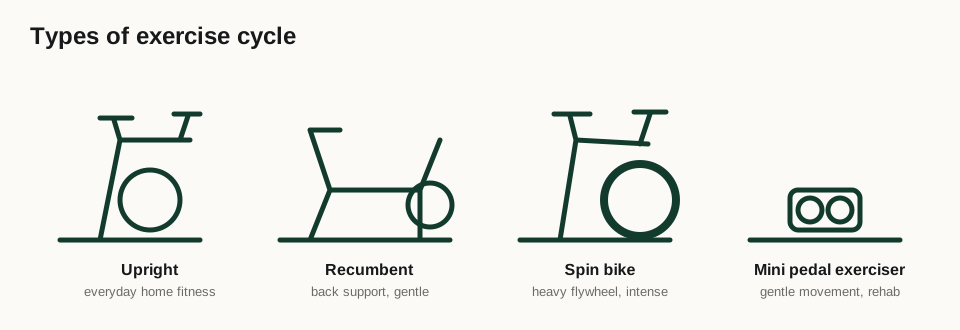
- Measures power (watts) precisely
- Used in labs, clinics, gyms
- Submaximal tests estimate VO2 max
- Not just an exercise bike
"Ergometer" means "work meter". A cycle ergometer is a stationary bike built to measure exactly how much work the rider does — which makes it the standard tool for cycling-based fitness and medical tests.
Ergometer vs ordinary exercise bike
| Cycle ergometer | Home exercise bike | |
|---|---|---|
| Workload | Measured precisely (watts) | Estimated or levels only |
| Calibration | Calibrated | Usually not |
| Use | Testing, training, rehab | General fitness |
| Price | Higher | Lower |
Many modern smart trainers and gym bikes measure power well enough for training. See the exercise cycle guide.
How a cycle ergometer works
Resistance comes from a mechanical brake (friction belt on a flywheel) or an electromagnetic brake. Electromagnetic ergometers can hold a set power (e.g. 100 W) whatever your pedalling speed — ideal for repeatable tests.
Common cycle ergometer tests
- Submaximal tests (e.g. the Åstrand-type or YMCA-style protocols): you ride at set workloads while heart rate is measured; aerobic capacity is estimated from the heart-rate response.
- Graded (incremental) tests: workload increases in steps until exhaustion, often with breathing-gas analysis to measure VO2 max directly.
- Sprint tests (e.g. Wingate-type): short all-out efforts to measure anaerobic power.
Submaximal tests are popular because they're safer and don't require an all-out effort.
Where they're used
- Sports science labs and team training
- Cardiology and pulmonary exercise testing
- Physiotherapy and rehabilitation
- Fitness assessments in gyms
Using an ergometer for training
Train by power zones rather than speed: set a target wattage and hold it. This makes indoor sessions precise and progress easy to track. For general benefits, see benefits of cycling.
Ergometers at home: smart trainers and power meters
You no longer need a lab to train by power. Smart trainers and some gym bikes measure watts reliably enough to follow a structured plan, and they let apps control resistance. They are not calibrated medical devices, but for personal training they work like an ergometer: you can repeat the same workload week after week and see progress clearly.
What a test result tells you
Fitness tests on an ergometer estimate how much oxygen your body can use (VO2 max) or how much power you can sustain. The useful part is the trend: repeat the same test every few months, under the same conditions, to see whether your training is working.
Frequently asked questions
What is a cycle ergometer?
A stationary bicycle that measures the exact workload — usually in watts — so exercise can be tested and repeated precisely.
What is a submaximal cycle ergometer test?
A test where you pedal at two or more set workloads while heart rate is recorded. The heart-rate response is used to estimate maximum aerobic capacity without an all-out effort.
Is a cycle ergometer the same as an exercise bike?
Every ergometer is an exercise bike, but not every exercise bike is an ergometer. Ergometers are calibrated to measure workload accurately; most home bikes only estimate it.
Who should do a cycle ergometer test?
Athletes, people in rehabilitation, and patients referred for exercise testing. Medical tests should be supervised by trained staff.
Tell us the rider's height, age and budget — we'll recommend a bike, whether or not we stock it.
Related guides
Types of cyclesExercise Cycle Guide: Types, Benefits and How to ChooseExercise cycles explained: upright, recumbent, spin bikes, air bikes and mini pedal exercisers — benefits, what to check before buying, and how to use one.Read guide → Riding in PakistanBenefits of Cycling: What Riding Regularly Does for Your HealthThe benefits of cycling for health, fitness, mood and everyday life, how much riding counts as enough, and how to start safely in Pakistan's heat and traffic.Read guide →Buying guidesBest Cycle for Fat Loss and Weight Loss: Type, Plan and TipsWhich cycle is best for weight loss — outdoor, exercise bike or elliptical — how often to ride, a simple 8-week plan, and the truth about belly fat.Read guide →Types of cyclesMini Cycle Pedal Exerciser (Mini Exercise Cycle): Uses and Buying TipsWhat a mini pedal exerciser is, how to use one for legs and arms, who it suits (older adults, desk workers, recovery), benefits and limits, and what to.Read guide →