Folding Cycle Guide: Are Folding Bikes Worth It?
A folding cycle folds in half (or smaller) so it fits in a car boot, a flat, an office corner or a lift. It's ideal if storage or carrying is your problem. Expect smaller wheels (usually 16–20 inch), a slightly twitchier ride and more weight than you'd guess — so check the folded size, weight and hinge quality before buying.
- Best for small spaces & car boots
- Wheels usually 16–20 inch
- Check hinge locks & folded weight
- Less suited to rough roads
If you live in a flat, keep your cycle at the office, or want to put it in the car boot for weekend rides, a folding cycle solves a real problem. Here's what to know before buying one.
How folding cycles work
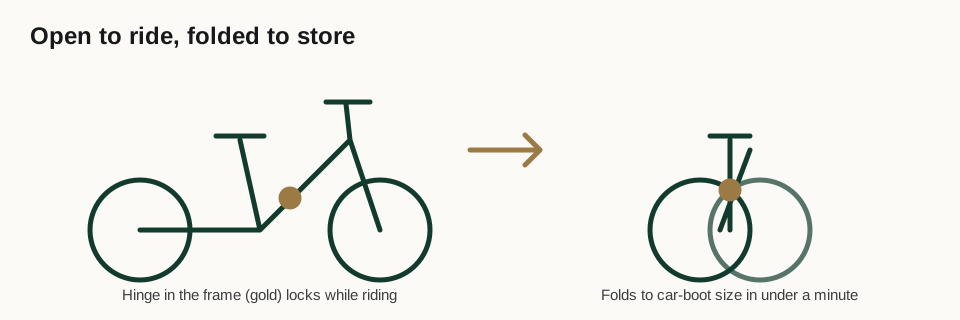
Most folding cycles have a hinge in the middle of the frame and another on the handlebar stem. The seat post drops down, the pedals may fold, and the bike halves fold together. Good designs fold in under a minute and lock together so they don't flop open while you carry them.
Pros and cons
| Pros | Cons |
|---|---|
| Fits in car boots, flats and offices | Small wheels feel bumps more |
| Easy to bring indoors (less theft risk) | Often heavier than expected |
| Mix with car or public transport | Hinges need checking and care |
| Adjustable to many rider heights | Fewer gears on budget models |
Wheel sizes
- 16 inch: very compact; best for short trips and carrying.
- 20 inch: the most common balance of ride quality and folded size.
- 24–26 inch: ride more like a normal cycle but fold less compactly.
What to check before buying
- Hinge locks: both should close firmly with no wobble. This is a safety point.
- Folded size: measure your car boot or storage space.
- Weight: lift it folded. You'll be carrying it up stairs.
- Maximum rider weight: listed by the maker; choose one with margin.
- Seat post length: taller riders need a long enough post.
- Brakes and gears: test them as you would on any cycle.
Who a folding cycle suits
- Flat dwellers without ground-floor storage, who'd rather carry a cycle into the lift than leave it outside.
- Office commuters who want the cycle under their desk instead of in a car park.
- Weekend riders who drive to a park, lake or quieter road and ride from there — a folding cycle fits in most car boots.
- Mixed-transport trips, where you ride part of the way and travel the rest by car or bus. Check first whether the bus or transport service you use allows folded cycles on board.
Folding cycle vs normal cycle
| Folding cycle | Normal cycle | |
|---|---|---|
| Storage | Tiny when folded | Needs a full-size space |
| Ride on rough roads | Firmer, feels bumps | Smoother on bigger wheels |
| Speed over long rides | A little slower | Better for long distances |
| Theft risk | Lower — it comes inside with you | Must be locked outside |
| Price for similar quality | Usually higher | Usually lower |
If you have space to store a normal cycle and don't need to carry it, a regular hybrid or sports cycle gives a smoother ride for the money.
Electric folding cycles
Folding e-bikes add a battery and motor, making them heavier but helpful for longer commutes and heat. See our electric cycle guide.
Caring for a folding cycle
Keep the hinges clean and check their bolts every few weeks. If a hinge starts to move or creak, stop using the cycle until it's tightened or repaired.
Frequently asked questions
Are folding cycles strong enough for adults?
Well-made folding cycles are designed for adults and list a maximum rider weight. Check it, and check that the hinges lock firmly with no play.
Are folding cycles good on Pakistani roads?
They're fine on reasonable city roads. Small wheels feel potholes more, so they're less comfortable on very broken roads or kacha paths.
How heavy is a folding cycle?
Many budget folding cycles are heavier than expected because of steel frames and hinges. Lift it folded before buying — you'll be carrying it.
Tell us the rider's height, age and budget — we'll recommend a bike, whether or not we stock it.
Related guides
 Types of cyclesElectric Cycle (E-Bike) Guide for Pakistan: Prices, Range and Buying TipsElectric cycles in Pakistan explained: pedal-assist vs throttle, batteries and range, charging, prices from about Rs 85,000, and what to ask before buying.Read guide →
 Types of cyclesSports Cycle and Racing Cycle Guide: What They Are and Who They SuitWhat 'sports cycle' and 'racing cycle' mean in Pakistan, the difference between road, hybrid and mountain-style sports cycles, and how to choose one.Read guide →
 Sizes & fitCycle Size Chart: The Right Inch Size by Age and HeightCycle size chart for Pakistan: kids' wheel sizes (12 to 24 inch) by age and height, adult frame sizes by height, and a simple at-home fit test.Read guide →
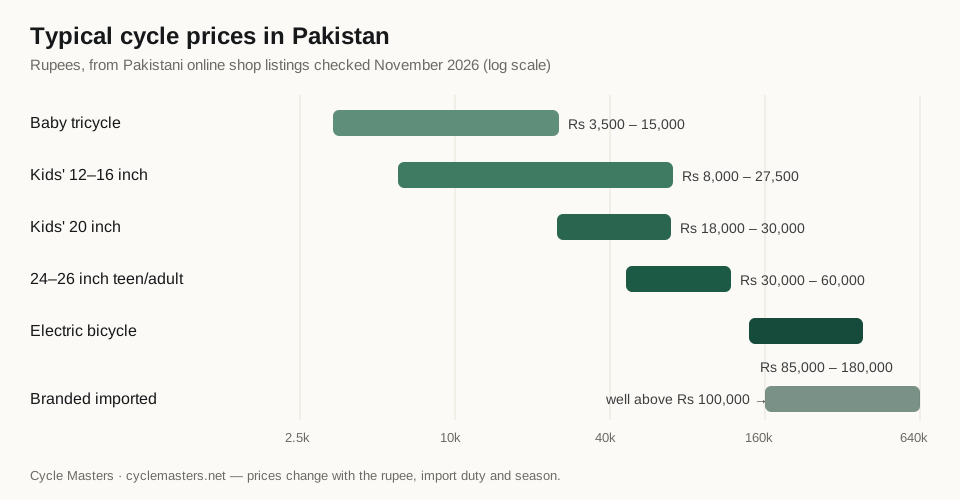 Cycle prices in PakistanCycle Price in Pakistan (2026): What You Should Really PayWhat a cycle costs in Pakistan in 2026: price ranges for kids', gear, sports, mountain, folding and electric cycles, and what you get at each budget.Read guide →